Techniques of learning to resolve deformable reconstruction and registration applied to laparoscopic images
The ATHENA project develops Artificial Intelligence (AI) technologies to improve minimally invasive oncological surgery (laparoscopy). This directly addresses the challenge of "Health, Demographic Change, and Well-being."
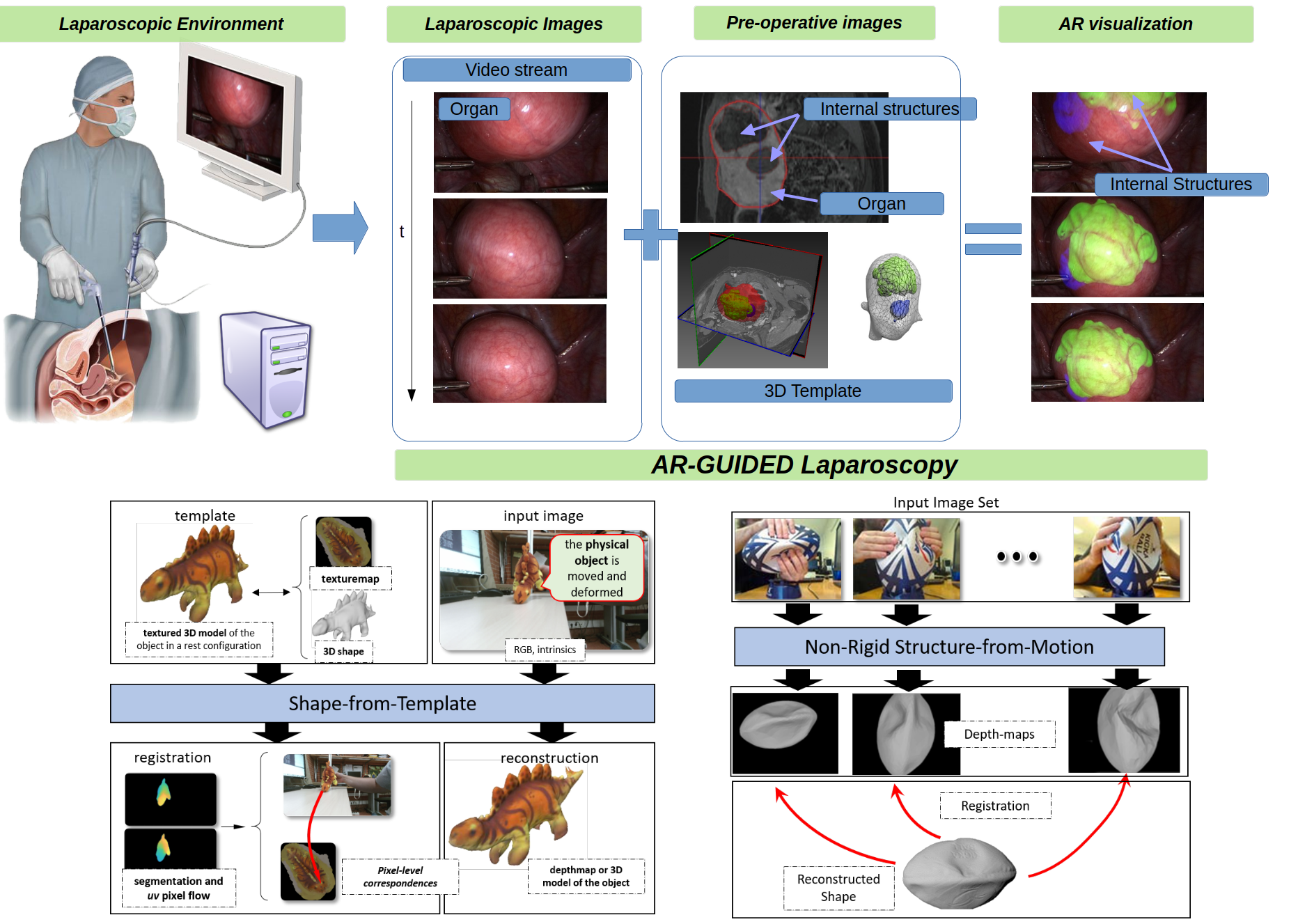
The main challenge in these surgeries is the difficulty of locating tumors hidden in deformable organs (such as the liver, kidney, or uterus), as the surgeon loses tactile and 3D perception. ATHENA's solution is based on Augmented Reality (AR), overlaying a 3D map of the organ and tumors onto the surgeon's video feed.
Key Innovation: We have developed novel Deep Learning algorithms to solve the complex problem of aligning a 3D preoperative map to a moving, deforming organ in real-time, without the need for complex synthetic data or external sensors.
Figure: Concept of SfT and NRSfM applied to surgery.
Study representations of templates, objects, and deformations capable of interacting realistically with Deep Neural Networks (DNN), focusing on thin-shell and volumetric objects.
Define a general DNN architecture to solve Shape-from-Template (SfT) and Non-Rigid Structure-from-Motion (NRSfM) end-to-end.
Develop methods to train DNNs using unlabeled images of deforming objects, utilizing optical flow and photometric error minimization.
Creation of synthetic and real (RGBD) datasets to standardize the evaluation of 3D deformable reconstruction in the scientific community.
Propose viable solutions for Augmented Reality guided laparoscopy for soft organs (specifically the liver) using the developed DNN methods.